

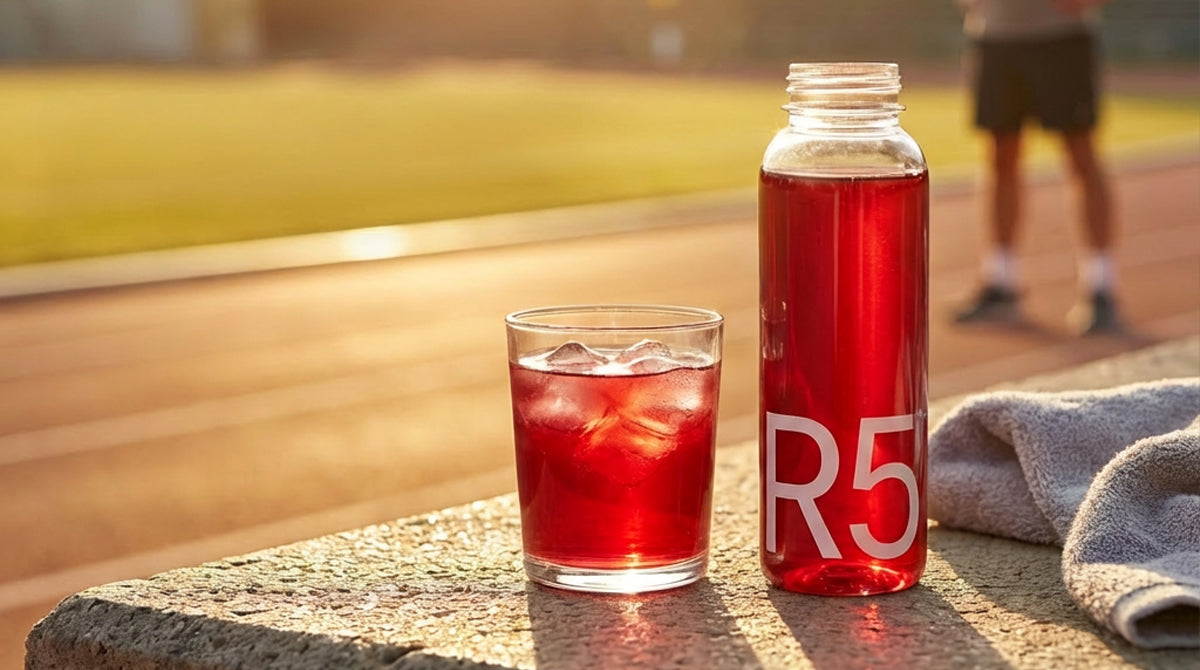
Beetroot is one of only three supplements — alongside creatine and caffeine — recognised by the International Olympic Committee as having strong evidence for improving exercise performance.
That's not marketing. It's the conclusion of the IOC's own review of sports nutrition evidence. And while beetroot juice shots have been a staple in elite sport for years, the science increasingly shows that the benefits apply to everyday active adults too — particularly those in their 40s and 50s who want to train harder, recover faster, and support cardiovascular health as they age.
Here's how it works, what the research actually shows, and how much you need.
How beetroot improves exercise performance
The performance benefits of beetroot come from one compound: dietary nitrate.
Beetroot is one of the richest natural sources of inorganic nitrate. When you consume it, your body converts nitrate into nitrite (with the help of bacteria in your mouth), and then into nitric oxide — a signalling molecule that plays a critical role in how your body delivers oxygen to working muscles.
Nitric oxide does three things that matter for exercise:
1. It widens blood vessels (vasodilation). Nitric oxide relaxes the smooth muscle in blood vessel walls, increasing blood flow to muscles. More blood flow means more oxygen and nutrients reaching the muscles during activity, and faster removal of metabolic waste products like lactate.
2. It reduces the oxygen cost of exercise. This is the most striking finding in the research. Beetroot supplementation has been shown to reduce the amount of oxygen your muscles need to perform at a given intensity. In practical terms, the same effort feels easier — or you can sustain a higher intensity for the same perceived effort.
3. It improves mitochondrial efficiency. Nitric oxide appears to improve how efficiently your mitochondria — the energy generators inside your cells — produce ATP. This means more energy output for the same fuel input, which translates to better endurance and less fatigue.
What the research shows
The evidence for beetroot and exercise performance is substantial and growing.
Endurance and time to exhaustion. Multiple systematic reviews and meta-analyses confirm that beetroot supplementation improves time to exhaustion during submaximal exercise. A 2017 review published in the Journal of the International Society of Sports Nutrition found that beetroot juice supplementation enhanced intermittent high-intensity exercise performance, with one study showing an 18.9% improvement in bench press repetitions to failure.
Running performance. A study published in the Journal of Applied Physiology found that runners who consumed beetroot juice before racing reduced their 5km time by approximately 1.5%. For a 25-minute 5km runner, that's roughly 20 seconds — a meaningful improvement from a single dietary intervention.
Oxygen efficiency. Research consistently shows that beetroot supplementation reduces VO₂ (oxygen consumption) at submaximal intensities. This means your cardiovascular system works more efficiently during exercise — a benefit that becomes increasingly important after 40 as cardiovascular efficiency naturally declines.
Muscular strength and endurance. A 2023 meta-analysis found that beetroot-based supplements can improve muscular endurance and attenuate the decline in muscular strength during fatiguing exercise. The effect was attributed to nitrate doses of 316–985 mg per day, consumed 2–3 hours before exercise.
Cognitive function. A double-blind crossover trial using RedNite® beetroot extract found that subjects who consumed 3 grams of beetroot extract 90 minutes before testing showed significant improvements in memory consolidation — a 20.69% increase in intermediate recall and 12.34% increase in delayed recall. This is relevant for active adults in their 40s and 50s who want both physical and mental performance support.
Blood pressure. Beyond exercise performance, beetroot nitrate has well-documented effects on blood pressure regulation. Nitric oxide-mediated vasodilation reduces both systolic and diastolic blood pressure, supporting overall cardiovascular health — a growing priority for adults in midlife.
Who benefits most from beetroot supplementation?
Here's something the research reveals that many people don't expect: beetroot supplementation appears to be more beneficial for recreational athletes and active adults than for elite competitors.
A 2025 umbrella review published in Nutrients analysed the population-specific effects of beetroot juice and found that non-athletes experienced more pronounced aerobic endurance improvements, while professional athletes saw greater muscular strength benefits. The explanation is straightforward: elite athletes already have highly optimised cardiovascular systems, so the marginal benefit of improved nitric oxide availability is smaller. For everyday active adults — especially those in their 40s and 50s whose cardiovascular efficiency is beginning to decline — the benefit is proportionally greater.
This makes beetroot supplementation particularly relevant if you're:
- Training regularly but not at elite level
- In your 40s or 50s and noticing declining endurance or slower recovery
- Doing a mix of cardio and resistance training
- Concerned about cardiovascular health and blood pressure
- Looking for a caffeine-free way to improve exercise performance
How much beetroot do you need?
Not all beetroot products deliver enough nitrate to make a difference. The research points to specific dose ranges:
Effective nitrate dose: 316–985 mg of nitrate per day, or approximately 5–9 mmol. This is the range used in the majority of positive studies and is consistent with IOC recommendations.
Timing: Consume 2–3 hours before exercise for acute benefits. Plasma nitrate concentrations peak approximately two hours after ingestion. Consistent daily supplementation over 3+ days also produces benefits, with more stable (though slightly smaller) effects.
Why whole beetroot isn't enough: A single whole beetroot contains roughly 70–350 mg of nitrate depending on size, soil, and growing conditions. The variability is the problem — you can't reliably control your dose. This is why standardised beetroot extracts exist.
RedNite® beetroot extract: RedNite® is a concentrated beetroot powder standardised to 1.5–2.75% natural nitrate. It contains 25 times more nitrate per gram than raw beetroot and is processed from fresh beetroot within 24 hours of harvest to preserve its nitrate content and antioxidant properties. It's the form used in the cognitive function trial mentioned above, and it's the form included in R5®.
Beetroot vs beetroot juice vs beetroot extract: what's the difference?
Raw beetroot or beetroot juice: Natural source, but nitrate levels vary widely depending on the beetroot variety, growing conditions, soil, and storage. You'd need to consume a large volume (typically 500ml of juice) to reliably reach effective nitrate levels. Many people find the taste challenging and the volume impractical as a daily habit.
Beetroot juice shots: Concentrated beetroot juice products (like Beet It) deliver a consistent dose in a small volume (typically 70ml). These are popular in sport but are designed as single-use pre-workout shots rather than daily supplements.
Beetroot powder (non-standardised): Dehydrated beetroot ground into powder. Convenient, but unless the product is standardised for nitrate content, the actual nitrate level per serve is unknown. Many cheap beetroot powders deliver well below the effective threshold.
Standardised beetroot extract (e.g. RedNite®): Concentrated and standardised to a specific nitrate percentage (1.5–2.75% for RedNite®). This guarantees a consistent, effective dose in a small serving. It's also fully water-soluble, vegan, non-GMO, and free from synthetic nitrates.
For consistent daily supplementation — rather than occasional pre-race shots — a standardised extract is the most practical and reliable option.
Beetroot and creatine: why they work together
Beetroot (nitric oxide pathway) and creatine (ATP energy pathway) improve performance through different and complementary mechanisms:
Creatine increases the availability of phosphocreatine in muscles, which your cells use to rapidly regenerate ATP during high-intensity activity. It directly fuels short, powerful efforts — think sprints, lifts, and explosive movements.
Read our guide to creatine after 40 →
Beetroot nitrate improves the efficiency of oxygen delivery and utilisation, reducing the energy cost of sustained activity. It supports endurance, cardiovascular function, and recovery between efforts.
Together, they cover both sides of the performance equation: explosive power and sustained endurance. This is why evidence-based performance supplements increasingly combine both ingredients rather than using one or the other.
For active adults in their 40s and 50s — who need both strength maintenance (creatine) and cardiovascular support (beetroot) — the combination addresses the two most significant age-related performance declines simultaneously.
R5® by REVIVE5 combines RedNite® beetroot extract with creatine monohydrate and five additional scientifically supported ingredients — L-Carnitine, L-Arginine, L-Taurine, L-Theanine, and Pomegranate — in a single caffeine-free daily drink. Learn more about R5® →
Key takeaways
Beetroot is one of the most well-supported natural performance supplements available. The science shows that dietary nitrate from beetroot improves blood flow, reduces the oxygen cost of exercise, enhances endurance, supports muscular performance, and may improve cognitive function.
The benefits are most pronounced in active adults who train regularly but aren't elite athletes — making it particularly relevant for people in their 40s and 50s who want to maintain performance as they age.
For reliable results, use a standardised beetroot extract (like RedNite®) at an effective dose, ideally combined with complementary ingredients like creatine for comprehensive performance support.
References
- Domínguez R, Cuenca E, Maté-Muñoz JL, et al. Effects of beetroot juice supplementation on intermittent high-intensity exercise efforts. Journal of the International Society of Sports Nutrition. 2017;14:2.
- Lansley KE, Winyard PG, Bailey SJ, et al. Acute dietary nitrate supplementation improves cycling time trial performance. Medicine & Science in Sports & Exercise. 2011;43(6):1125–1131.
- Tan R, Cano L, Lago-Rodríguez Á, Domínguez R. Effects of beetroot-based supplements on muscular endurance and strength in healthy male individuals: a systematic review and meta-analysis. Journal of the American Nutrition Association. 2023;42(8):775–793.
- Vaccaro MG, Innocenti B, Cione E, et al. Acute effects of a chewable beetroot-based supplement on cognitive performance: a double-blind randomized placebo-controlled crossover clinical trial. European Journal of Nutrition. 2023;62(8):3451–3459.
- Domínguez R, Maté-Muñoz JL, Cuenca E, et al. Effects of beetroot juice supplementation on cardiorespiratory endurance in athletes: a systematic review. Nutrients. 2017;9(1):43.
- Zhang Y, Zheng L, Li T, et al. Effects of beetroot juice on physical performance in professional athletes and healthy individuals: an umbrella review. Nutrients. 2025;17(12):1958.
- IOC consensus statement on dietary supplements and the high-performance athlete. British Journal of Sports Medicine. 2018;52(7):439–455.
See the peer-reviewed research →
Creatine After 40: Why It's Not Just for Bodybuilders Anymore
The Ingredient That Makes R5 Feel Different